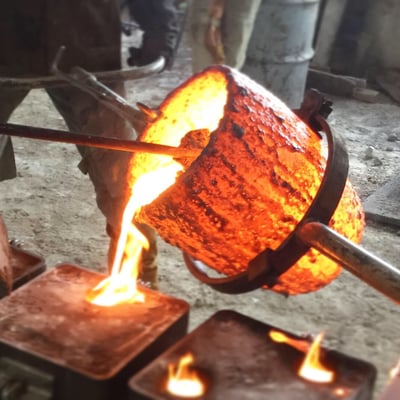
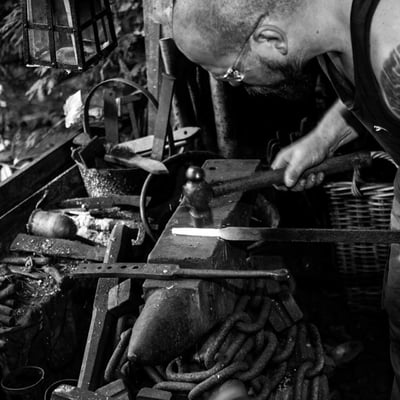
This course begins on Saturday morning and follows the standard content and sequence. Residential students only need to stay overnight on Saturday, as the schedule has been adjusted to finish later on Sunday with an extended afternoon session.
This course will introduce a range of techniques through a structure of continuous tutor demonstration and student practice and will complement the skills of the Blacksmith with metalworking techniques and is suitable for beginners, as well as those wishing to enhance their skill set.
You will work on the following: detailed use of the fire, drawing down tapers in different cross sections, hot cutting, bending in different cross sections, spiral forming, twisting techniques, various tools and techniques for shaping, curving and forming.
You will learn how to mark out metal elements and use the pillar drill, cut to size, abrasion techniques and machine cutting.
You may, if you wish, bring ideas of your own or evolve an idea to work on, subject to the constraints of practicality and time, or combine techniques into different smaller scale objects as led, demonstrated and suggested during the course by the tutor. These are made in combination with the techniques demonstrated.
By the end of the course, you should have had a good introduction to the techniques of the blacksmith and metalworker and you should feel more competent with understanding and recognising how these techniques are applied in decorative, functional and sculptural metalwork. You should be able to confidently undertake further explorations of this fascinating and rewarding craft.
Included
On this course, the College will supply all materials required for the specific techniques set by the tutor, including all fuel costs and metal that is stocked by the College.
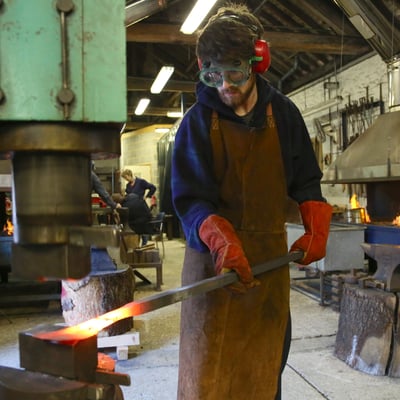
Leather aprons, welding gauntlets, goggles, welding helmets and ear defenders can be borrowed from the Forge.
What students need to bring
You will need to wear clothing suitable for workshop use, together with steel toe capped boots. Please note that cotton or wool clothing is preferable to nylon or other synthetics. Shorts do not provide necessary protection. For your safety, it is mandatory to wear steel toe capped safety boots when undertaking a course in the Forge. You must provide your own footwear and bring them with you to wear on the course. If you fail to bring suitable footwear, you will not be able to take part in the course. Safety boots can be purchased from most tool hire shops and builders merchants, as well as online.
You must wear goggles (provided) and suitable protective clothing for this course. Leather aprons, welding gauntlets, goggles, welding helmets and ear defenders can be borrowed from the Forge or you can bring them along if you have them. If, for example, you have particularly large or small hands, your own leather work gloves are likely to be a better fit.
Available to buy
Available from shop:
Sketchbook, pencil, rubber
Additional information
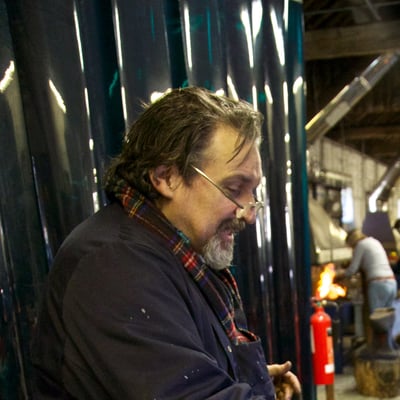
Please note: This course will be in the Forge, which is a ten-minute walk from the main house through the walled garden, or can be accessed by car. As this course is held in the Forge, morning coffee and afternoon tea will be held in the nearby Carrington Studio.
Please note that tutor supervision is always required when you are working in the Forge.
Saturday
Student registration: 9.45am
Course teaching: 10am-5pm
Morning session: 10am-1pm including coffee/tea break
Lunch break: 1pm-2pm (lunch included)
Afternoon session: 2pm-5pm including coffee/tea break
Teaching finishes: 5pm
Sunday
Course teaching: 9am-4pm
Morning session: 9am-1pm including coffee/tea break
Lunch break: 1pm-2pm (lunch included)
Teaching finishes: 4pm