Year 1
Unit 1: Relief
18 -21 October 2026 | 3-days
In Unit 1, you will approach the most fundamental of printmaking techniques, relief, with a contemporary approach full of vigour and energy. Learning about the historical roots of relief print and the earliest known examples of relief print, you will learn from this and look at how artists are placing it in the contemporary arts arena. You will look at numerous approaches to relief printmaking from artists past and present, and how these may guide and inform your personal practice.
In the unit, you will learn linocut, woodcut, wood engraving, letterpress, and plaster cast relief prints. You will work as a group to develop advanced techniques in a select few of these approaches to build confidence in graphic design elements as well as more alternative approaches to the relief print. You will be looking at both monochrome and colour work and start to develop an understanding of how these choices can inform the emotions and communicative outcomes of the end impression. The tutor will work with the group to demonstrate the use of presses and hand printing techniques and why and when you would use these.
From a fundamental start in the essence of relief work, the unit will build in energy and approaches, showcasing the full potential of this genre of print. The use of the specialist letterpress facilities will be utilised during the unit and integrated as part of the teaching programme. The unit will be led through demonstrations and group projects, enabling you to explore all elements of the module to ascertain which best suits your language of expression to move forward into the future programme.
A brief will be set to guide you through the processes, which in conjunction with your own interests, will begin to inform your creative ideas. These skills will be adapted to beginner and intermediate levels guided by individual needs and personal achievements.
A short one-to-one tutorial is designed to mentor your ideas, to help time manage your self- directed study and to develop a framework for your research and making over the intervening weeks to bring to the next unit. This tutorial will be held during the time at West Dean College. In between each unit, an interim tutorial on a set date will be allocated to have a 40-minute virtual tutorial on Teams with the tutor.
Interim virtual tutorial for Unit 1: 15 December 2026
Unit 2: Intaglio
24 -27 January 2027 | 3-days
The session will begin with a group discussion of works explored and developed from the previous unit, and any learning experiences this brought up. We will look at how some of these learning experiences can be brought forward into this unit as inspiration for development and confidence building.
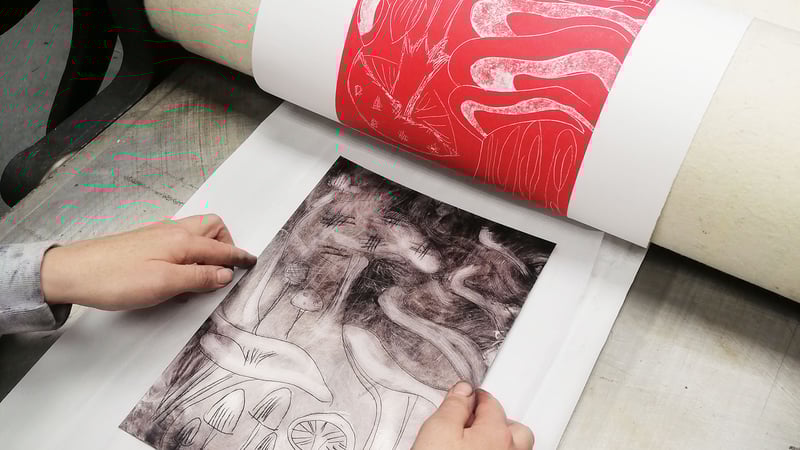
Unit 2 will focus upon intaglio printmaking. The approaches to intaglio in this Foundation are rooted in ecological approaches and cover dry point (aluminium and paper), mezzotint, collograph and intaglio on lino. These approaches to intaglio work cover a huge, dynamic library of expressive approaches without the use of strong acids or salts and can be fully replicated in the home studio without specialist ventilation facilities or chemical disposal. The key link to all these approaches is the style of inking up and wiping down, which is the backbone to any intaglio print work. We will look at this and the history of why this developed and how it is used in a contemporary setting by artists.
Through a range of demonstrations and practical projects in each medium, you will be supported in unleashing a wilder side to intaglio work, breaking free from the more traditional fine line work. The approaches to intaglio mark-making will stem from traditional tools through to more unusual approaches working with handheld engravers, kitchen implements and power tools. These approaches will support you in generating a library of a range of marks that are capable in each medium.
We will start to discuss as a group how similarities, differences and potential crossovers between relief and intaglio and be seen. We will look at possibilities of how you can learn from the marks capable in each and how you can use this to develop each medium further. Your tutor will set a specific project to prepare inspiration for Unit 3.
Interim virtual tutorial for Unit 2: 16 March 2027
Unit 3: Planographic
25 – 28 April 2027 | 3-days
Planographic printmaking will cover monoprint, stencil print and lithography. You will enter a world of more autographic and direct drawing, taking you on a journey that started with quite a graphic introduction to print in Unit 1. This unit is all about direct, energetic marks. Grounded in our experiences of printmaking thus far, you will use the confidence built in mark-making and layering to look at how you can both be spontaneous and in control.
The module will start with working on monoprint, both in colour and monochrome. You will work with stencils, ink transfer, viscosity work and complex layering approaches. You will work on set time specific based projects to push your intuitive drawing strength and to generate energy in print. From your grounding in monoprint, you will delve into the world of lithography. Lithography on lino and photo plate, both of which can be printed and worked with readily in the home studio. You will work with tusche washes, traditional litho materials and more unconventional approaches. You will start looking at incorporating digital imagery in and amongst autographic mark-making and the potential this offers.
At the end of this unit, we will have an informed group discussion looking over what you have learnt over the first three units. This will inevitably inform unit 4, where we start to mix it all together. You will be guided on what preparation to bring ahead of the hybrid unit.
Interim virtual tutorial for Unit 3: tbc
Year 2
Unit 4: Hybridisation and Unique Impressions
29 August–1 September 2027 | 3-days
This unit is where you will take everything you have learnt thus far, put it in a huge mixing bowl, and bake something quite amazing. Hybrid printmaking focuses on the unique print, celebrating print as a unique expressive art form.
Working from inspiration and journeys you have developed over the first three modules; you will generate a series of unique hybrid prints. These learning projects will be both group-led and developed closely with one-to-one guidance by the tutor. You will look at the practicalities of hybrid printing, such as wet-on-wet ink or damp-to-dry paper. You will learn advanced technical approaches to integrating lithography with intaglio, relief with monoprint, digital with autographic. Through demonstrations, you will look at how you can print on different substrates beyond paper and how print can delve into the realms of sculpture.
This is truly the most energetic unit and will involve diving from press to printing barren, inks to lino and back. You will be guided every step of the way to learn, document and develop outcomes suited to your expressive journey in print.
Interim virtual tutorial for Unit 4: 9 November 2027
Unit 5: Advance Colour and Design Work
9 – 12 January 2028 | 3-days
What makes a print? This unit discusses a hugely vital component of printmaking; how does the artist generate the end impression? From inspiration, to how one designs and chooses which techniques, ideas and strategies for making new work and whether to work in colour or not. Printmaking has so much potential up its sleeve. This unit is about supporting you in disseminating the day-to-day studio decisions that make a print sing.
You will build confidence in graphic composition, pattern, flat areas of colour and work larger scale. Practical approaches in scale, editioning, colour and planning will be demonstrated. You will look at artist examples and how they have developed a print and the reasons why. You will be guided through group discussion and small, targeted projects to build confidence in making the decisions that face artist printmakers every day.
The unit will end with small one-to-one discussions to ensure you have enough guidance, support and technical expertise to carry out self-directed work in unit 6. Any specialist facility requests will be discussed now to ensure needs are met.
Interim virtual tutorial for Unit 5: 9 March 2028
Unit 6: Self-directed Practice and Workshop Management
9 - 12 April 2028 | 3-days
This unit is where you will explore your own practice under the expert guidance of the tutor. With continued support throughout, this is the opportunity to fix any niggling problems, troubleshoot techniques and utilise specialist facilities with the tutor’s help and guidance.
The unit will be structured to make sure all your needs are met, to ensure that the complete portfolio meets your needs. As part of the self-directed unit, your tutor will also lead you in how to set up efficient home print studios, waste management in the studio, ecological approaches and how to pursue print further beyond the Foundation Diploma. These talks will be group-based and a chance for you to ask questions to enable you to feel you have enough support to pursue printmaking in your own space.
There will be an assessment of the research and technical journals that you will have worked on throughout the two years.
The final essay must be submitted following the successful completion of the six units of study. The essay must be completed within two months after completing the final unit by 13 July 2028.