Twined Pod forms with spiral patterns with Mary Crabb

Ref: S1D40532

Places available

About this course

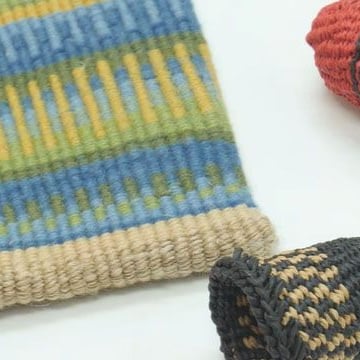
Learn how to form a small 'pod' using a twining basketry technique. Twining is worked in the hands and use a few simple tools. Learn the basics and sample colourful spiral patterns.

Course Description

The course will focus on the technique of twining, making a connection with both basketry and textiles. We will be making ‘pods’, a term Mary uses to describe a small woven vessel/basket.

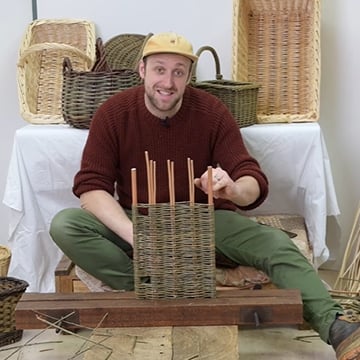
Twining requires the weaving of an active element around a passive warp. The weaving is worked in the hands with the use of a few simple tools. Twining does not require the use of a loom. Basics of joining in new material, changing colours, patterning and finishing will be covered. All students will work on the same simple form, with a recipe supplied by Mary.

Learn how to twine, with the aim of making at least one spiral pod. The pod will be made from colourful paper yarn. Colours will be a major consideration in the design, with a choice for the warp and weft. Once the form is established, we will work with two or more colours at the same time, which will enable a chasing spiral design to weave like magic around the pod! Intermediate students may wish to explore the spiral design to vary the outcome.

Mary will demonstrate techniques, provide visual notes and offer individual support to enable you create your own unique twined pod. A suitable day for students with no experience of twined basketry. Please note that the work is small-scale and twining can be tiring on the hands. Please consider this before booking.
Course Materials

Included

In this course, the tutor will supply all of the materials, including paper, yarn, needles and instruction sheets.

All necessary equipment will be provided for use in the course.

What students need to bring

  • A notebook/sketchbook and pencil as you may wish to note additional information.
  • Reading glasses if you need them for close work.
  • A camera (optional)
  • Examples of twined baskets, if you have any.
  • Asthma and hay fever sufferers are recommended to bring any medication, as occasionally the fibres from some threads and strings may bring on symptoms.

Additional information

Please wear appropriate clothing/aprons for the workshop or studio; this includes stout covered footwear (no sandals or open toes).

Timetable

Student registration: 9.15am-9.30am  
Course teaching: 9.30am-5pm  
Morning session: 9.30am-1pm  
Lunch break: 1pm-2pm (lunch included)  
Afternoon session: 2pm-5pm  
Teaching finishes: 5pm  

General Information

Tutors

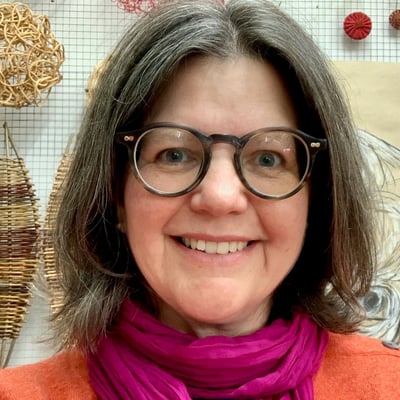
Mary Crabb

Mary Crabb is an award-winning contemporary basketmaker. Having originally worked in willow, Mary now works with fine flexible materials, both natural and man-made, to create small, detailed and decorative woven forms exploring the connection between basketry and textiles.

Courses of interest

Basketry masterclass - additional techniques

Online
Buy course
Tutor: Eddie Glew |
Masterclass: Intermediate/Advanced
£57

Basketry masterclass - key aspects of English square work

Online
Buy course
Tutor: Mary Butcher |
Masterclass: Intermediate/Advanced
£57

Textile basketry - exploring twining

Online
Buy course
Tutor: Mary Crabb |
Suitable for all
£47

Kumihimo – Japanese braidmaking

10 to 13 Mar 2026 | West Dean
Places available
Tutor: Jacqui Carey |
Suitable for all
£471
Further study options for art craft and design short courses

Further study options

Take the next step in your creative practice, with foundation level to Masters in Fine Art study. 

Depending on your experience, start with an Online Foundation Certificate in Art and Design (one year, part-time), a Foundation Diploma in Art and Design made up of 10 short courses taken over two years (part-time) or advance your learning with our BA (Hons) Art and Contemporary Craft: Materials, Making, and Place (six years part-time). All will help you develop core skills, find direction in your practice and build an impressive portfolio in preparation for artist opportunities or higher-level study. See all degree and diploma courses.