Emily Myers
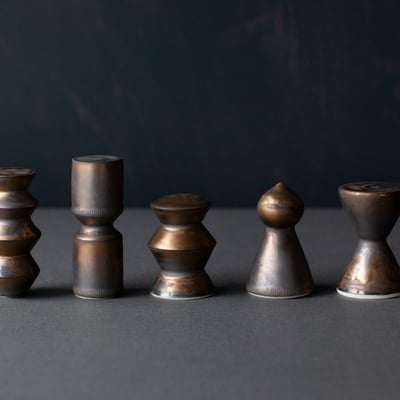
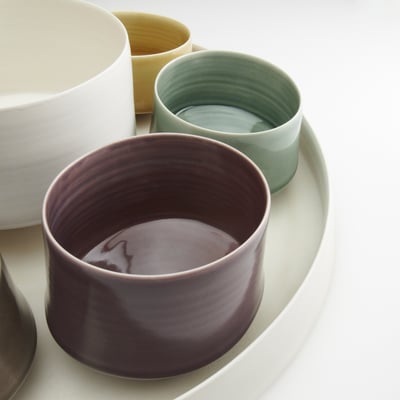
Emily Myers has been a Fellow of The Craft Potter’s Association since 1990. She trained at Camberwell and Bristol Art School in the late 1980s.
Ref: S3D40165
West Dean Heritage Craft Week Immerse yourself in the rich traditions of heritage crafts with our Heritage Craft Week and learn time-honoured techniques from expert instructors. Whether you're a beginner eager to explore a new craft or an experienced artisan looking to refine your skills, you'll not only acquire practical skills but also connect with a deeper sense of history and craftsmanship.
This course is designed to encourage you to improve your throwing skills, and to learn how to facet and carve at the leather-hard stage. The emphasis will be on producing pieces, but not to be too precious about them. More pots to work on will enable you to hone your skills and to experiment with form and surface.
At the introduction evening, the tutor will show examples and pictures of faceted pots made by a variety of potters and will also show some objects that inspire her, such as seedpods. This will be a good time for you to sketch out your ideas.
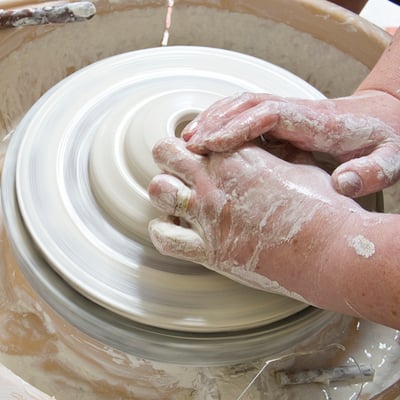
The tutor will teach techniques to throw taller forms, such as vases and bottles, giving options to those of you with more basic throwing skills. Your tutor will demonstrate how to spiral wedge clay and stress the importance of clay preparation. She will give various throwing demonstrations, showing her own particular tricks, for example, standing up whilst throwing to get taller forms.
You will spend the first day wedging and preparing your clay, and throwing a variety of evenly thrown forms, which will be left to dry overnight. Forms will include small stem vases and larger bottles.
On day two, the tutor will demonstrate how to facet the pots using a banding-wheel and harp tool. You will work on your own pots; repetition of the process will help you gain fluidity in the making process. The afternoon will be used for throwing new forms, including rounder vases.
On the last day the tutor will demonstrate fine carving lines with loop tools and also how to use a metal kidney to texture surfaces. You will carry on experimenting with carving and faceting your own pieces, concentrating on roughly 4 pieces to take home.
The cost of clay/glazing materials and firing costs of work made – large work in size and quantity may be charged extra.
Available from shop:
Firing and glazing options:
Arrival day - first date of course
Residential students can arrive from 4pm, non-residential students to arrive by 6.45pm for registration
Student welcome, followed by dinner: 6.45pm (dinner included)
Teaching session: 8pm-9pm (attendance is essential)
Daily timetable
Course teaching: 9.15am-5pm
Morning session: 9.15am-12.45pm including coffee/tea break
Lunch break: 12.45pm-2pm (lunch included)
Afternoon session: 2pm-5pm including coffee/tea break
Teaching finishes: 5pm
Evening working: students may have access to workshops until 9pm, but only with permission from the tutor and provided any health and safety guidelines are observed.
Departure day - last date of course
Course teaching: 9.15am-3pm (lunch included)
Teaching finishes: 3pm
Residential students will need to check out of rooms by 10am.
Please note, the tutor may make slight variations to the daily timetable as required.
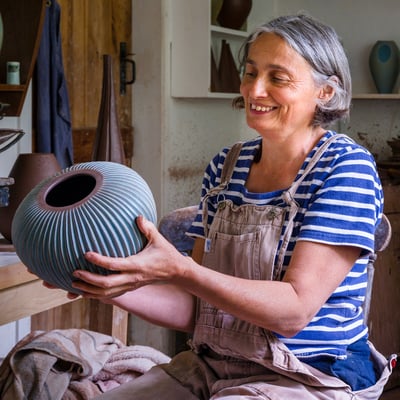
Emily Myers has been a Fellow of The Craft Potter’s Association since 1990. She trained at Camberwell and Bristol Art School in the late 1980s.
Residential option available. Find out accommodation costs and how to book here.
Take the next step in your creative practice, with foundation level to Masters in Fine Art study.
Depending on your experience, start with an Online Foundation Certificate in Art and Design (one year, part-time), a Foundation Diploma in Art and Design made up of 10 short courses taken over two years (part-time) or advance your learning with our BA (Hons) Art and Contemporary Craft: Materials, Making, and Place (six years part-time). All will help you develop core skills, find direction in your practice and build an impressive portfolio in preparation for artist opportunities or higher-level study. See all degree and diploma courses.