This course is part of our Making Skills: for Degree and Diploma Study, a themed series of short courses that teach foundation skills and offer an insight into studying one of our Higher Education courses at West Dean.
They cover a variety of subject areas and are taught by selected tutors who teach on the Degree and Diploma courses at West Dean, giving students a real insight into the opportunities available for full or part time study. They also offer an excellent opportunity to create and build on your portfolio, often a key requirement when you apply for a higher education programme, develop you practical making skills and find out if you would like to pursue further study.
There will also be opportunities to Meet the Tutors on Tuesday 8 September, with an evening event starting at 5:15pm in The Old Library, where each tutor will give a 10 minute talk about their practice and course. Workshop and studio tours will also be scheduled as part of the week, offering students the chance to see the full range of facilities and courses West Dean offers.
Course details
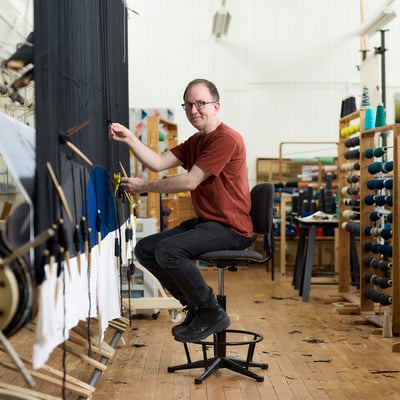
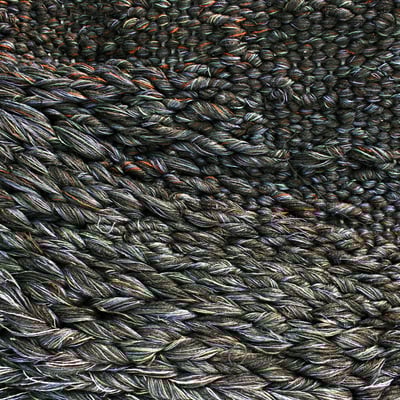
When beginning a new tapestry, there are several aspects weavers need to consider while planning a new project. This course aims to help inform a new project you have in mind as you will work on a small sample to try out how you might translate your ideas for design.
The following will be covered:
- How to choose or design an image to translate and consider the scale
- Technical aspects, warp setting, weft, cartoon production, use of specific materials and techniques
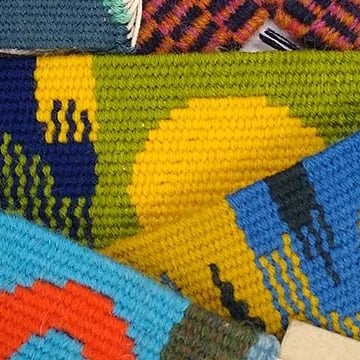
- Colour blending and shading techniques in tapestry
For this course students can bring examples of artwork that they are interested in translating into woven tapestry.
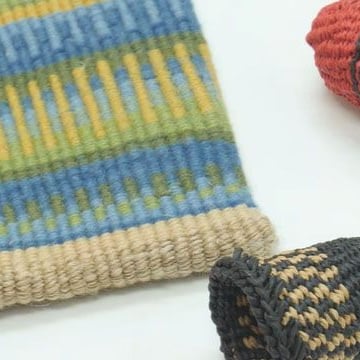
The course will begin with an introduction to the different techniques and stages illustrated with examples of work. There will also be an open discussion on the image that you wish to translate. You will create a 10 cm wide sample piece using a cotton warp with woollen weft to explore the different ways of translating marks relating to your image into tapestry.
Contemporary blending and shading techniques in woven tapestry will be explored; alongside how different colours behave when woven together and how colour can be combined with the use of different materials and/or weaving techniques in order to achieve a particular effect. While the main technique will be flat woven tapestry, related techniques such as wrapping, knotting and tufting can also be demonstrated and tried, if appropriate. Further demonstrations will be given as the course progresses.
As the your sample progresses a variety of other materials such as linen, cotton, wire/metallic threads etc., may be introduced into the weft depending on their suitability for the image you have selected. You will work independently with a group crit at the end of the course.
By the end of the course you will have an understanding of how to develop a personal approach to translating your artwork into tapestry. The samples produced are intended to be used as future reference for when working independently on a finished peice.
Making Skills: for Degree and Diploma Study
Other subjects and short courses on this themed week are:
Printmaking: Combined Techniques
Attendance on the above course offers skills relevant to progressing onto Foundation Diploma in Printmaking
Tapestry Weaving: The Art of Translation
Attendance on the above course offers skills relevant to progressing onto Foundation Diploma in Tapestry
Painting Inspired by Goldsworthy’s Chalk Stone Walk
Attendance on the above course offers skills relevant to progressing onto Foundation Diploma in Art & Design and BA (Hons) Art & Contemporary Craft
Textiles - Techniques to Tell Stories and Experimental Concrete Casting for Sculpture
Attendance on any of the above courses offers skills relevant to progressing onto BA (Hons) Art & Contemporary Craft
Printmaking: Combined Techniques, Experimental Concrete Casting for Sculpture and Tapestry Weaving: The Art of Translation
Attendance on any of the above courses offers skills relevant to progressing onto Graduate Diploma Fine Art and MFA Fine Art
Silversmithing with an Emphasis on Box Making and Blacksmithing: Fundamentals and Individual Projects
Attendance on any of the above courses offers skills relevant to progressing onto FdA Metalwork (Craft Practices)
Woodworking: Tool Control, Posture and Precision
Attendance on the above course offers skills relevant to progressing onto FdA Furniture (Craft Practices)
Bookbinding Sampler: Designing and Creating a Sewn Notebook and Introduction to the Conservation of Books and Archives
Attendance on any of the above courses offers skills relevant to progressing onto FdA Books & Bindings (Craft Practices)
Introduction to the Conservation of Books and Archives
Attendance on the above course offers skills relevant to progressing onto Graduate Diploma Conservation and MA Conservation
Practical Skills in Conservation
Attendance on the above course offers skills relevant to progressing onto Graduate Diploma Conservation
Interior Design Intensive – Process, Planning and Presentation
Attendance on the above course offers skills relevant to progressing onto BA (Hons) Interior Design and HE Diploma Interior Design
Find out more and View all Courses