Slate Carving In Relief with Paula Haughney

Ref: SLW41757

Places available

About this course

Slate is a metamorphic rock that carves beautifully, achieves interesting textures and takes a polish. Using reclaimed slate, washed smooth by a tidal river, hand carve a simple design of your choice - flora, fauna or a pattern.

Course Description

The aim of this course is to introduce you to carving slate in relief. You will be given instruction on how this is to be achieved through to the finishing stages, plus the joys of hunting for and using reclaimed materials.

Slate is a fine grained metamorphic rock from an original shale type rock, composed of clay or volcanic ash. It has been used widely for roofing tile and, because of its thermal stability and chemical inertness, it was used for laboratory bench tops and billiard tables. Information will be provided on the geology and where slate is found. There are so many types and colours. There will be examples of natural slate and worked pieces to look at, plus lots of visual imagery to inspire you.

The slate you will be using was industrial waste found in a tidal river. It was pre-cut into batons and oblongs and discarded during the 19th century. Since then, it has been rounded into interesting shapes by tidal action. It is thicker than roof tiles and doesn’t cleave. The pieces are generally 2-4 cm thick.

The first evening session will be a practical one, with an introduction to the studio in the Sculpture Courtyard and health and safety instructions. 

The first project will familiarise you with the tools needed to shape the slate and, with these, you will create patterns on a thin, stick like baton. If there is time that evening, you will also smooth and polish.

The next project, the next day:

First, you will choose your slate - some will polish black, others a shade of plum.
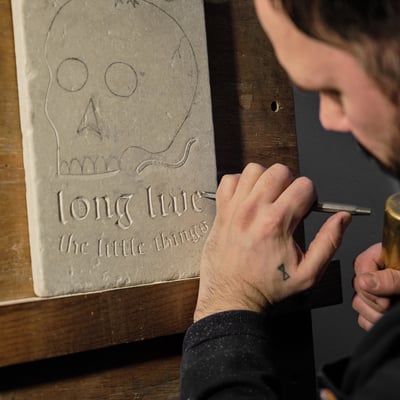
Then, your chosen design will be drawn or traced onto the stone with a white pencil. A demonstration will be given on the techniques of hand carving the slate, chasing out the outline and removing the background, finer detail and texture, finishing with the smoothing and polishing when heated. The time taken will depend on size, complexity of design and ability, but you might be able to complete more than one.

The course is taught by group demonstrations and discussions, plus one-to-one tuition.

A display of work at the end of the course will be mounted in the workshop to celebrate the journey and the outcomes.
 

Course Materials

Included

Specialist tools for you to use during the course.

What students need to bring

Simple designs that can be adapted to the shape of the old slate, usually oblong
Sketchbook
Drawing materials and white pencil for drawing on the slate
Camera/phone for recording
Apron or overalls, hat, gloves to work in or to handle slate (need to fit).
Sun cream if working outside or umbrella if forecast shows rain.
 

Available to buy

Slate will be available to purchase from the tutor at £4 per kilo.  The price for most students will be under £10 - depending on the weight of the slate. 

Additional information

Please note: your workshop will be in the Sculpture Courtyard which is a 10-minute walk from the main house through the walled garden or can be accessed by car. The Sculpture Courtyard is open on one side so be prepared for any type of weather. Morning coffee and afternoon tea will be held in the nearby Carrington Studio.  You will return to the main house for lunch.

Please wear appropriate clothing/aprons for the workshop or studio, this includes stout covered footwear (no open toes or sandals). Safety boots if possible. Carving slate is a dusty activity, safety equipment (safety glasses and ear defenders) can be borrowed, masks are provided but you might like to bring fitting gloves to work in. Eye protection and face masks are supplied by the College and are essential. Full health and safety instructions will be given. Stone carving is a physical activity, and it is most effective when standing up but can be achieved sitting down.
 

Timetable

Arrival day - first date of course
Residential students can arrive from 4pm, non-residential students to arrive by 6.45pm for registration  
Student welcome, followed by dinner: 6.45pm (dinner included)
Teaching session: 8pm-9pm (attendance is essential)

Daily timetable
Course teaching: 9.15am-5pm  
Morning session: 9.15am-12.45pm including coffee/tea break  
Lunch break: 12.45pm-2pm (lunch included)  
Afternoon session: 2pm-5pm including coffee/tea break  
Teaching finishes: 5pm    
Evening working: students may have access to workshops until 9pm, but only with permission from the tutor and provided any health and safety guidelines are observed.

Departure day - last date of course
Course teaching: 9.15am-3pm (lunch included)  
Teaching finishes: 3pm  

Residential students will need to check out of rooms by 10am.
Please note, the tutor may make slight variations to the daily timetable as required.

General Information

Tutors

Paula Haughney

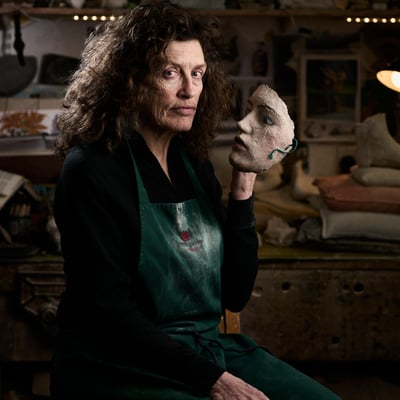
Paula Haughney,sculptor, stone-carver, maker and teacher studied at Portsmouth Polytechnic and Eastern Illinois university obtaining a BA and MA in Fine Art Sculpture. Stone carving came later, once found, she realised this was her chosen medium. Now having over 30 years experience and many monumental sculptures completed she has taught at all levels, exhibits regularly and is included in public collections worldwide.

Accommodation

Residential option available. Find out accommodation costs and how to book here.

Courses of interest

Stone carving – fantastic fish and shiny shells

7 to 13 Aug 2026 | West Dean
Places available
Tutor: Paula Haughney |
Suitable for all
£1,332

Sculptural woodcarving with found wood

7 to 13 Aug 2026 | West Dean
Places available
Tutor: Alex Jones |
Suitable for all
£1,319

Introduction to stone carving

4 to 6 Sep 2026 | West Dean
Places available
Tutor: Simon Keeley |
Beginners/Intermediate
£433

Interested in a career in woodworking?

Our Foundation Degree specialising in Furniture is designed to give you well-rounded woodworking theory and craft skills to become a self-employed maker or craftsperson, to continue your studies in higher education or to find employment in the creative industry sector. Find out more