FDAD drawing day (online) with Kate Boucher

Ref: SDD41198

Location: Online
£78

Places available

About this course

The focus of Drawing Days is to explore drawing in its broadest sense and to develop confidence in self-directed study.

Course Description

Unruly Botanical Patterns with Charcoal invites you to explore how drawings can evolve away from direct observation and into energetic, expressive patterns. Working from botanical sources—either from life or photographic reference—you will investigate how creative ideas develop along a line of enquiry, allowing forms to shift, fragment, repeat, and become increasingly abstract.

You will learn a range of charcoal‑based techniques using natural and compressed charcoal, putty and plastic rubbers, stencils, frottage, brushes, and fabrics. These approaches will help you create drawings with boldness, complexity, subtlety, and nuance, embracing the unpredictable and atmospheric qualities of charcoal.

The course begins with an introduction to the theme, including examples of Kate Boucher’s work and selected works by Kitsuko Ozeki, Sarah Amoss, Kim Van Someren, and Joyce Silverstone. Although these artists may not all work botanically or in charcoal, their practices offer rich insights into pattern, abstraction, and the possibilities of monochrome.

A sequence of demonstrations and guided tasks will support you to:

  • Use charcoal and its related tools with increasing confidence
  • Build layered drawings that balance structure with expressive freedom
  • Develop drawings away from source images or objects through a sustained line of enquiry

By the end of the day, you can expect to have a clearer understanding of how to:

  • Handle charcoal with greater skill and versatility
  • Build drawings in layers without concern for ‘mistakes’
  • Generate visual interest from both objects and photographic imagery
  • Draw on the influence of other artists to expand and deepen your own ideas
Course Materials

What you need

Preparation
Organise your source material in advance as follows:

  • Three botanical sources to work from. These may be physical plant material or your own primary‑source photographs
  • If using photographs, please print them out. They may be in black and white or colour. Choose images that interest or excite you, rather than ones you think will be easy to draw. Consider experimenting with close‑ups, dense or tangled foliage, oblique angles, compositions that fill the frame, or dappled light
  • One image of an artist’s work that interests you and connects in some way to pattern, abstraction, or botanical forms. This may be printed or digital

These objects and images will act as the starting points for a series of drawings that gradually move away from direct representation and into expressive, unruly pattern. You will work between your sketchbook and loose sheets, using only natural and compressed charcoal.

Materials

  • A handful of willow charcoal sticks in medium or mixed thicknesses
  • Two brands of compressed charcoal (for example Seawhite, Jakar, Conté, or Faber‑Castell). Compressed charcoal can be sold in a box called ‘grey set’, you need ‘black set’. The grey set only has one actual compressed charcoal; the rest have chalk mixed in
  • One eraser: natural rubber, plastic or vinyl, preferably Milan, Koh-in-or Natural Rubber, Staedtler Mars or Faber‑Castell Vinyl
  • One putty rubber
  • Four sheets of A3 smooth white or off-white paper, at least 140 gsm or heavier, either loose or in a pad. Some sheets will be cut down during the course
  • One sheet of smooth white paper to use as a base sheet, approximately A2 in size
  • Fixative: can of aerosol spray varnish, Spectrafix, or unsweetened soya milk (decanted neat into a mist‑spray bottle)

Tools and Equipment

  • A small piece of sandpaper of any grit, roughly the size of a business card
  • Kitchen towel or paper tissue
  • A clean, dry fabric rag approximately 20 × 20 cm, made from cotton, polycotton, an old T‑shirt, muslin or similar, for blending charcoal
  • A clean, dry J‑cloth, dishcloth, tea towel, or duster for blending charcoal
  • One large soft‑bristle brush, such as a make‑up powder brush
  • One stiff‑bristle brush, such as a decorating brush or a stiff acrylic or oil brush
  • A cutlery knife, letter opener, or plastic knife (not sharp)
  • A camera or smartphone/tablet to document your work
  • Your sketchbook or sketchbooks
  • Masking tape

These tools support a wide range of mark‑making, erasure, blending, and surface disruption, all of which are essential for developing layered, expressive charcoal drawings.

Workspace
Have your base sheet set up ready to work on top of. You’ll be leaning on it and using it as a palette. You may want to put some small pieces of tape to hold it steady while you work.

Timetable

Please be sure to be in the Zoom Room at 8.55am so the session can start promptly. There will be a short refreshment break mid-morning and afternoon of 15 minutes, the tutor will let you know about this on the day.

Timetable

  • 9am: All students to join Zoom
  • 12.30pm: Lunch (1 hour)
  • 4pm: Finish

General Information

Tutors

Kate Boucher

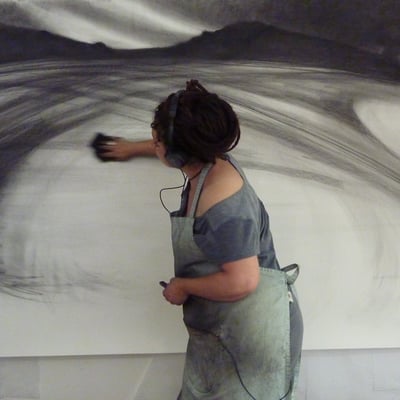
Kate Boucher is an experienced, enthusiastic and inspirational tutor who specialises in building students' creative confidence in a supportive teaching environment. She trained at Chelsea School of Art and recently gained a Master of Fine Art from West Dean College. She was awarded a prestigious QEST scholarship, was the Edward James Foundation Scholar in 2015/16 and winner of the Valarie Power Prize for Visual Arts. Her dark and evocative charcoal drawings often have unnaturally tilted horizons, hints of a double exposure and foregrounds that appear to shift and slip. Her practice also includes handmade felt and forged metal structures also created as a response to landscape.


Accommodation

Residential option available. Find out accommodation costs and how to book here.